Il faut pratiquer!
This past weekend I was lucky enough to go to Paris with my friends Rebecca and Sally, for Rebecca’s birthday. We also met up our friend Francis, who is researching his PhD at the Sorbonne, and my brother’s girlfriend Kate, who is there working for the OECD currently.
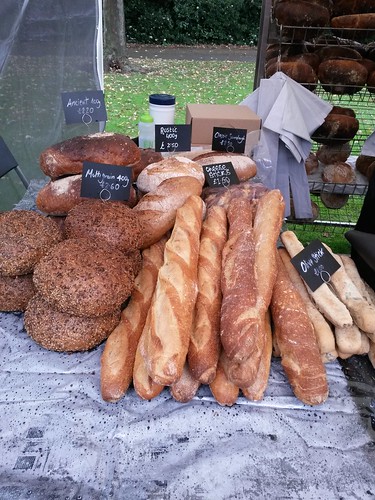
We’d all been to Paris before so were there for the catching up rather than the sightseeing. This led us to buy some cheese (Comté and Bleu d’Auvergne), baguettes (the best I’ve ever tasted), and sweet treats (tartes and macarons) and head for the Bois de Boulogne for a picnic. Not before we were introduced to Frank’s landlady though, who interrogated us in French for at least half an hour! Bit of unintended practice there but I at least managed to follow most of the conversation and take part when prompted. If only I remembered half the French I learned at school.
Sunday was free museum day – on the first Sunday of the month all national museums are free. We wanted to go to the Petit Palais but it was shut due to it also being a public holiday. So we braved the crowds at the Louvre. Deliberately going nowhere near La Joconde, we discovered the crowds were bearable after all. I spent most of my time in Napoléon III’s apartments and looking at Renaissance objets d’art – in particular a lot of very finely carved ivory. All I could think about was the poor elephants.
Then it was back to London, an hour late due to some idiot leaving their luggage unattended at the Gare du Nord. Such a short trip, and it has really whet my appetite for more. I realise how much of Paris I still have to see.

Cèps are in season. I intend to buy some the next time I’m at Borough. Along with more Comté, which interestingly is the same price here as in Paris.
Poetry Cafe
As some of you may know, I have been working at the Poetry Society lately putting together the world’s largest knitted poem.
What you may not know is that the Poetry Society has an excellent cafe. It seems like every day the chef comes up with something new – in the months that I have been going there, I have only had a meal repeated about two times, and even then there is often something new or different about it.
The menu is short and always contains a soup, main, salad, cheese and bread, and muffin. But there is always something new and the food is consistently good. There is always something I want to eat.
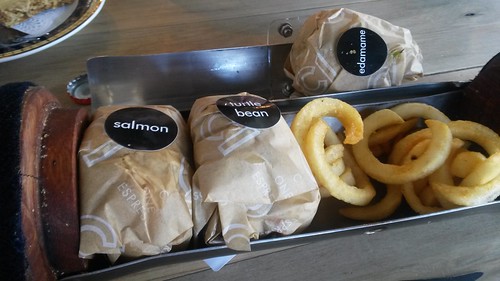
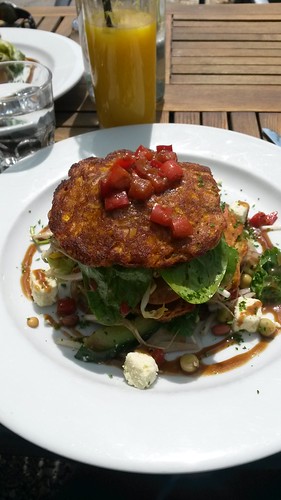
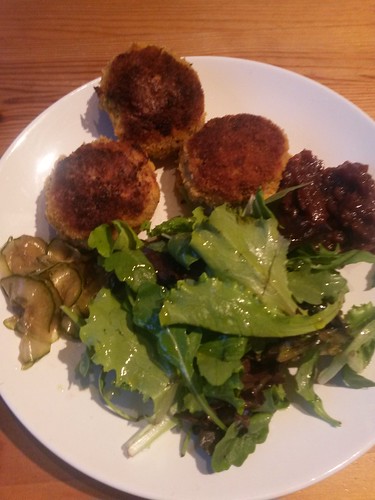
The day I took these photos I ordered the spicy beanburger wrap. It was absolutely delicious.
One of my companions ordered the tomato and feta salad, and was very impressed when it arrived:
Now that the poem is finished, I will miss eating there. But I know I will go back from time to time.
Photo walk
A friend of mine invited me along to a photo walk around Holborn last weekend. Basically it involved a few of us walking around taking photos. It’s a nice way to get a bit of practice in and look at the city from a different angle.

We found this apple tree in Lincoln’s Inn Fields, and managed to pick a few. The skin was tough (once we’d rubbed the smog off) but the flesh was delicious. There should be more fruit trees in public spaces.
Fifteen
A couple of weeks ago I was lucky enough to be invited to Jamie Oliver’s restaurant Fifteen. Jamie Oliver set up the restaurant in order to train disadvantaged young people to be chefs and give them a start in life. What a fantastic idea. The restaurant is funded through takings, donations and merchandise. Which brings me to why I was there – the launch party for Fifteen’s new knitting kit.
What’s knitting got to do with a restaurant, you ask? Well, the wool in each kit comes from Fifteen’s lamb supplier in Wales. So I think it’s rather fitting!
The food was absolutely divine: (photos courtesy of Stitch and Bitch seeing as I forgot my camera)
The limited edition knitting kit (complete with beautiful wooden needles and patterns) can be purchased here.
Autumn vegetables
I have often said Autumn is my favourite season. I love the colours, the afternoon light on a sunny day, the crisp mornings, the woolly jumpers.
And the food. My last couple of vegetable boxes have been delicious, albeit with a bit of a glut of carrots, potatoes and sweetcorn. Once I got sick of eating corn on the cob, I made corn fritters, a Friday night favourite since my student days. However the oil got a little overexcited and spat into my face… and then the phone rang, and I ended up with a blister on my cheek! So with the next batch I made corn and chili soup, with a mixture of minced chili and dried chipotles for more depth of flavour.
With some of the potatoes and carrots, I decided to try out a recipe for vegetarian goulash I found in 200 Veggie Feasts, kindly sent to me by the publisher, Octopus.
It was fairly similar to similar vegetable stews I have made in the past – not really the sort of thing I need a recipe for. I am usually a little more generous with the dumplings as I love them. I would normally add some beans for protein as well. There are some nice looking recipes in the book though and I look forward to trying them when the contents of my veg box allow.
I also made a large quantity of butternut squash risotto.
I love butternut squash and have another in my box this week. I want to make something different this time though. Ideas?
Vindolanda, Week 2
In week two we were moved from the North Field over to the main site.
Tania and I were put on an area that hadn’t been fully excavated the week before, on part of a road. Tania quickly found another road surface below, from an earlier fort. She was set to work excavating this.
James was not far away, excavating part of a drain:

In that photo he is tunnelling under a capstone, that was used to cap the drains. Most of these are now broken or gone. The drains would probably have been lined in wood as well.
I spent the first day rather puzzled as I couldn’t find any of the lovely smooth cobblestones Tania was uncovering. Instead what gradually appeared were a series of large rocks in a row. It turned out I had hit a lower portion of the drain James was excavating.
Some finds from the drain:

A lovely piece of glass. You can tell it’s Roman because it has bubbles in it. The Roman’s hadn’t figured out how to get air bubbles out of glass. This would have come from the bottom of a vessel, a cup for instance. I also learned that the reason we don’t find much glass is that unlike pottery, when glass broke, the Romans recycled it!

This is from an iron blade of some sort.

This was definitely the most I managed to pull out in a single day. The large piece of pottery in the lower left corner is from a mortarium, a mixing bowl with grit stuck in the inner surface to aid in grinding food, like a mortar and pestle.

One of these is a nail. One is an eye pin. Can you tell which?
Tania had some impressive finds from the road:

Green glass bead.

Part of a bronze crossbow brooch.
On the final day (which was also the final day of digging for the entire year) James and I had a big push to join our trenches together, and Tania tried to get her road to the edge of the ditch.
And believe it or not, we made it:

Now I really want to sign up for the first week of next year’s dig season so I can pick up where I left off! There really is something completely addictive about digging. I learned a lot about myself and my abilities and was pleasantly surprised. I didn’t expect to enjoy the experience as much as I did, but I enjoyed every minute of it, and can’t wait to go back. I even had my eye on a house up there, if only I had the money to buy it!
The Valley Connection
For dinner one night we went to an Indian restaurant called The Valley Connection in Hexham. It was right next to Hexham Abbey so had lovely views out the window.
The menu boasted that the restaurant was one of the top 10 Indian restaurants in the UK. I took that with a pinch of salt. It contained your standard Indian fare with a selection of slightly more innovative dishes. So I decided on the Tandoori Trout:
It was excellent. We also had a starter of onion bhajis, a side of channa dal and shared a Peshwari naan. The bhajis had the right amount of crunch and the spices in them tasted wonderfully fresh. The chickpeas melted in our mouths. My first bite of naan was from a thicker part of the bread and actually contained some uncooked batter, but the rest of it was divine. It was the best Indian food I’ve had in the UK (that’s counting Tayyabs, where I finally went last week). If that was in the top 10, I’d quite like to seek out the other 9 now!
Allen Banks and Staward Gorge
Allen Banks is a National Trust-owned property not far from where we were staying. One day after digging we went there for a walk, and did the Woods Walk. This was through woodland planted in Victorian times by the local lady of the manor to provide some pleasant forest walks. She built several summerhouses in the woods. Unfortunately none of these survive, but one has been completely recreated from photographs:
Another day I got up at 6am to go for a sunrise walk. The north end of the Allen Banks property was a short walk across farmland from our holiday cottage. There was lovely light for taking photos.
The last photo is looking out from a very narrow promontory, with steep drops either side, and the sound of the river roaring deep below. This led to the ruins of a medieval fort, brilliantly situated for defence. The fort was never attacked and the only reason it is ruined is because the stone was used to build a manor house.
A couple of days later I went back in the evening with Tania. The evening light was very different:
Vindolanda, weekend
We had two days free between our first and second weeks of digging. We had planned a lot of activity, including a trip to Hexham, the local town, a forest walk, and a walk along Hadrian’s Wall. However on the first day we woke up to pouring rain, and had a lazy day inside followed by a quick trip to Hexham.
On the second free day however we hit the wall, walking from Steel Rigg, near the Once Brewed visitor centre, to Housesteads fort – about 3 1/2 miles. We would then catch the Hadrian’s Wall bus back to the visitor centre and walk back to the car from there.
This is one of the most spectacular sections of wall and I took a lot of photos…

A milecastle. These were placed at every Roman mile along the wall, with two turrets in between. Forts were at roughly a day’s march from each other.

Sycamore Gap, otherwise known as the Robin Hood Tree, as the tree was apparently made famous in the Kevin Costner film.
We arrived at Housesteads and looked around the museum before checking the bus timetable and finding the next bus was at 5pm. We got down to the car park where the bus was due at 4:55, only to see the bus whizzing past.

Time for another 3 1/2 mile walk down the road…

Vindolanda pre-dates Hadrian’s Wall so is actually situated about a mile south of the wall itself.

When we saw Sycamore Gap again I knew we were nearly there.
Then it was a final push up a steep hill to where we had parked the car, before I could finally enjoy a well-deserved pint of local ale at the Twice Brewed pub.
Vindolanda, week 1
I was a bit apprehensive on our first day of digging! I’ve never really thought of myself as an outdoorsy person, despite growing up in New Zealand and spending several years living on a farm. And outdoor sports, with mud, rain, and cold? No thanks!
However, there’s something very invigorating about the country air, and surprisingly I didn’t suffer at all from hayfever while I was there, so my energy levels were high. We were each given a wheelbarrow, a bucket, a spade, a shovel, a hand shovel, trowel, garden kneeler and brush. Armed with these we followed our supervisor Beth up the road, through a gate and into what was called the North Field. This was actually part of a neighbouring farm where we had permission to dig.
Beth explained that the building we were digging up was some kind of aisled barn – one very large room, divided into aisles by columns. We could also find traces of walls from an earlier building, and to the north some drainage ditches that were possibly used for some kind of industry. The building had already been excavated right down to floor level; our job was to dig under the floor to the natural clay below, to see if we could find any more clues about what the building was used for.
The first few days were rough going, as the patch we’d been assigned to contained a lot of large rocks. However, it also contained various bits of Roman pottery and extremely rusty iron nails. The digging got very addictive, as we never knew what would be under the next rock. I started to build some muscle up and rocks that I couldn’t lift at the start of the week, I could effortlessly lob onto the spoil heap by the end of the week.

This is Beth holding up a slate roof tile someone found on the first day of digging. Beth was thrilled as before then we didn’t know whether the building had a slate or thatched roof.

Base of an amphora handle, from the huge pottery jars that were used to store and transport olive oil, wine and other goods.

Tania found these lovely pieces of Samian ware. This kind of decorated pottery was made in France and imported.

Some kind of iron pin. This was my first “small find”. Most of the items we found just got put into large bags that were labelled with the area we were digging in. These would be cleaned and then sent to the museum. Slightly more important finds got their own “small find” bag.

Ignore me and the nail I’m holding, and look down by my feet. The rocks down there are the beginning of a wall I found near the end of the week. This would have been from the earlier building on the site.
One day we arrived to find that some ramblers had opened a gate, letting some cows into the field. One of the cows had a calf so we were a bit wary. We managed to get past them to the dig site safely, but then they got curious and came over to inspect:
They were a bit aggressive but finally lost interest and wandered off. It definitely lent some excitement to the morning though.

Tea break! The North Field is visible over my shoulder.
On the final day of the week we were rained off. Work stops if the rain is just too heavy to work in. So we spent some time in the Vindolanda museum before driving down the road to Chesters fort. Chesters has been well excavated and includes an impressive bath house:

Cubby-holes in the changing room.
There’s also an underground strong room in the headquarters building.